
Maharaja Hari Singh Nalwa
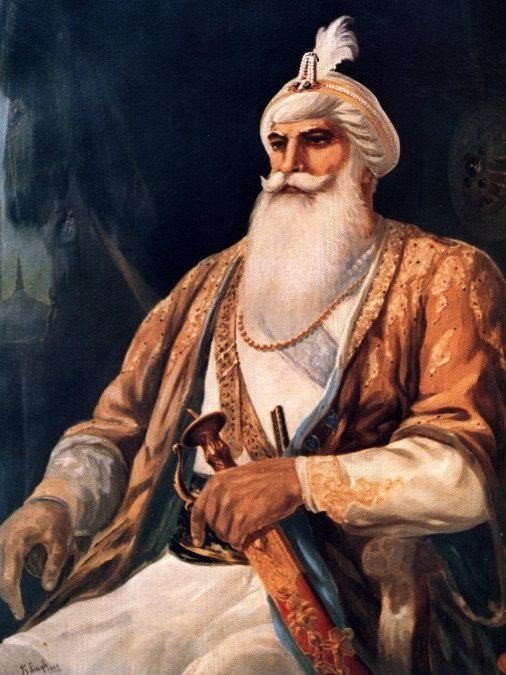
Basic Information
Field Details
Full Name: Sardar Hari Singh Nalwa
Birth 1791 CE, Gujranwala (now in Punjab, Pakistan)
Death 1837 CE, Jamrud Fort, near Khyber Pass (present-day Pakistan–Afghanistan border)
Father: Gurdial Singh Uppal
Mother:Dharam Kaur
Clan/Community: Uppal Jat Sikh
Religion Sikhism
Titles Nalwa (“The Lion”), Baba Sher-e-Punjab, Frontier Commander
Service ▸️ Commander-in-Chief of the Sikh Khalsa Army under Maharaja Ranjit Singh
Kingdom Served Sikh Empire (1799 – 1849)
Early Life
Hari Singh was born in 1791 in an Uppal Jat Sikh family at Gujranwala, the same town in which Maharaja Ranjit Singh was born.
His father, Gurdial Singh, died when he was very young. Hari Singh was raised by his mother, Mata Dharam Kaur.
He was trained in horse-riding, swordsmanship, and archery. Soon, he joined the service of Maharaja Ranjit Singh around 1804–1805.
Military Career and Major Achievements
- .first- Battle – Kasur (1807)
His first major fight was the Battle of Kasur against Afghan forces led by Qutb-ud-Din.
He showed great bravery, and was given the title “Nalwa”-meaning “the ferocious tiger”.
Ranjit Singh rewarded him with a jagir.
2. Conquest of Multan (1818)
He took part in the siege of Multan, one of the Afghan strongholds.
He helped annex Multan into the Sikh Empire, breaking Afghan control over southern Punjab.
3. Conquest of Kashmir (1819)
He led a major division of Sikh troops through mountainous terrain.
He defeated Afghan governor Jabbar Khan, bringing Kashmir under Sikh control. This was one of his greatest victories.
4. Campaigns in Peshawar and the Frontier (1822–1834)
He was appointed Governor of Kashmir in the year 1820, and he was later made Governor of Peshawar and Hazara.
He built a number of forts to save India from Afghan and Pathan raids:
Jamrud Fort
– Haripur Fort (founded 1822)
– Jehangira Fort
– Nowshera Fort
His administration brought peace and prosperity to the turbulent frontier regions.
5. Battle of Nowshera (1823)
He led the Sikh forces to a decisive victory over the Afghan army of Azim Khan.
This further solidified the control of the Sikhs over Peshawar.
6. Khyber Pass Expedition (1837)
He fortified Jamrud, a key post near the Khyber Pass, marking the farthest western boundary of the Sikh Empire.
He battled hard against the Afghan forces of Dost Mohammad Khan.
Although he was badly injured, Hari Singh’s resistance continued until the reinforcements arrived, thus securing Jamrud.
He died in action at Jamrud in April 1837, defending India against Afghan invasion.
Administrative Achievements
He gave the name Haripur to the town he founded in 1822, one of the first planned cities ever designed in the region with paved streets and a water system.
He established fair tax and justice systems in the frontier provinces.
He encouraged agriculture and trade across the Sikh-Afghan borderlands.
Legacy
He is remembered as the most fearless general of the Sikh Empire.
His name inspired fear amongst Afghans. A famous saying of that era was:
“Khaibar da sher aa gaya – Hari Singh Nalwa!
Aya sher e Khyber – My beloved, Hari Singh Nalwa!
During his governance, the Khyber region remained peaceful, which no one was able to do before or after him.
After the British annexed Punjab in 1849, they recognized his frontier expertise and maintained his forts.
Statues of him stand today in Amritsar, Gujranwala, Haripur, and Delhi. India issued a postal stamp in his honor in 2013.
- Death
Year: 1837 CE
Place: Jamrud Fort, Khyber Pass
Cause: Mortally wounded in battle against the Afghan forces, he died defending the Sikh frontier.
Aftermath: The Sikh Empire retained Jamrud. It was not captured by the Afghans because of his heroic stand against them.
Quick Facts
Category Information
Born 1791 (Gujranwala, Punjab)
Died April 1837 (Jamrud Fort, Khyber Pass)
Community / Gotra : Uppal Jat Sikh
Title Given by Ranjit Singh “Nalwa” — The Tiger Major Conquests Kasur, Multan, Kashmir, Peshawar, Jamrud Founded City Haripur (1822) Served Under Maharaja Ranjit Singh (Sikh Empire) Legacy Symbol of bravery, military skill, and frontier security of India