
Maharaja Ranjit Singh
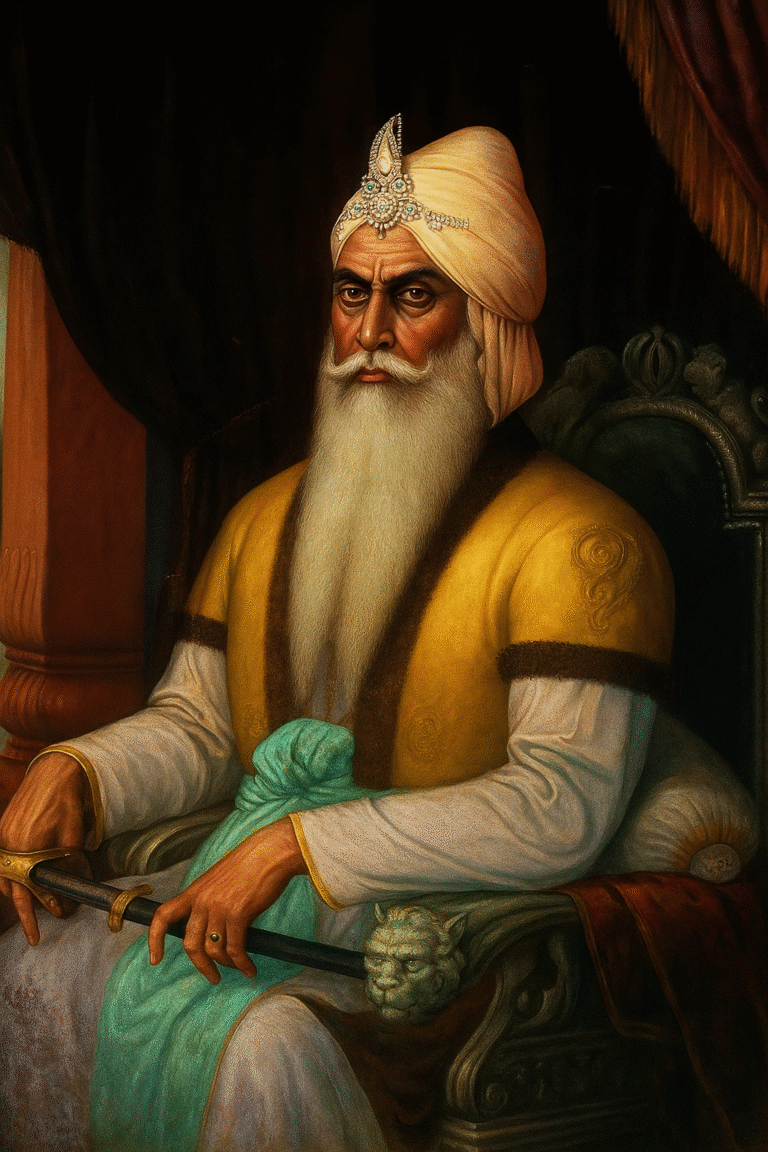
Who was he?
Maharaja Ranjit Singh (1780–1839) was the founder of the Sikh Empire in North India. Born in Gujranwala to a Jat Sikh family of the Sandhu clan, he started life not in silk halls, but amid dust, battles, and hardship. Smallpox tried to break him early, leaving one eye blind, but the world soon learned that kings are not judged by sight, but by vision.
How did he rise?
His father was a chief of the Sukerchakia misl (a Sikh warrior clan), but Ranjit Singh didn’t just inherit power. He welded scattered territories into a single strong empire. Piece by piece, like fitting steel plates on a shield, he united Punjab.
His Empire
He became Maharaja in 1801 and built a kingdom that stretched from the Khyber Pass to the Sutlej River. Picture that span: mountains, rivers, cities buzzing with trade, farms spreading like green quilts.
His style of rule
He was known for:
• Secular leadership. Hindus, Muslims, Sikhs all served in his court.
• Strong defense. He modernized his army with European training.
• Golden Temple care. He covered the Harmandir Sahib in gold. Yes, the sparkle you see today owes much to him.
• Justice & peace. Under his rule, Punjab was safe enough that, as old stories say, “a lone woman could walk with gold on her head and not fear.”
Personality & legacy
He wasn’t a king who floated in silk clouds. He wore simple clothes, lived among soldiers, and walked through markets talking to people. Imagine a lion wearing wool instead of gold. That was him.
After his death in 1839, the empire slowly fell apart and later went under British rule. But his name still rings like a war drum and a temple bell together: strength and grace.
In short
Maharaja Ranjit Singh was a Jat Sikh leader who rose from clan chief to emperor, built a mighty Punjabi empire, ruled with fairness, protected faith and culture, and remains one of India’s greatest warrior-kings.